


The Symmetry Trap: When Balance Beats Matching
I'll start with a confession. If you've ever worked with me, you already know this about me. I am always trying to make things symmetrical. Sometimes to a fault.
Matching nightstands. Matching lamps. Twin chairs flanking the sofa. Art centered with mathematical precision above the fireplace. There's a pull in me toward order and mirror images that's been hard to shake. I'm recovering. I really am.
And that's exactly why I'm writing this one. Because after years of designing homes and noticing which rooms feel alive versus which ones feel frozen, I've learned something that went against my instincts for a long time: symmetry isn't always the answer.
The Safety of Matching
Our brains love symmetry. It reads as order, as intention, as design with a capital D. When you're furnishing a room you've invested in, reaching for a matching pair feels like the responsible choice. It's the decorating equivalent of wearing the outfit you know works. There's comfort in that predictability.
But there's a difference between intentional design and designed-to-look-untouched. When we walk into a bedroom with perfectly matched nightstands and the exact same lamp on each side, we're seeing control, yes. We're also seeing caution. Caution that asymmetry might look careless. Caution that balance requires mirror images.
I know that caution. I've lived in it.

When Symmetry Actually Works
Let's be clear: symmetry has its place. Formal entries benefit from it. A real fireplace with architectural bones often demands it. A dining room with a long table centered in the space, formal drapery flanking windows, a chandelier overhead, these elements create a sense of occasion and ceremony that symmetry serves beautifully.
But most of life doesn't happen in those rooms. Most of life happens in the spaces where families actually sit, read, work, and wind down. Those rooms need something different.
The Stiffness Factor
There's a reason hotel rooms and show houses can feel so polished and so cold at the same time. They're built on symmetry. Perfect, pristine, untouched by time or personality. A room designed primarily for symmetry can read as a room where nothing has ever actually happened.
When we design custom homes for families, we're designing for life as it's actually lived. That requires a different approach. It requires asymmetry, even when (like me) every fiber of your being wants the opposite.
Balance Is Not Symmetry
Here's what finally shifted things for me: understanding that balance and symmetry are not the same thing. A room can feel perfectly balanced without a single matched pair in it.
Balance is about visual weight. A tall plant on one side of a sofa can be balanced by a substantial bookshelf on the other. One large piece of art can carry the same visual presence as three smaller pieces arranged differently. A chunky ceramic lamp and a stack of design books can hold the same weight as a decorative mirror. Nothing feels heavier or emptier than anything else, but nothing is repeating itself either.
That's where a room starts to feel designed by someone who knows what they're doing. Not because things match, but because there's intention behind every choice and confidence in the arrangement.

How to Start
If matching is your instinct (as it still is mine), here's how to begin shifting. Choose one item and deliberately choose something different for the opposite side. Maybe one nightstand stays, and the other becomes a low dresser with a different lamp. Maybe one side of your sofa gets a large plant while the other gets a narrow console with books and objects. You're not creating chaos. You're creating balance through intention.
The key is visual weight and scale. Understand what draws the eye and what holds space. A small table with a tall plant can balance a large bookcase. A pair of small artwork pieces can feel as grounded as one large piece, depending on how they're arranged.
Asymmetry forces you to think. It forces you to understand why something works, not just that it matches. And that's exactly what separates a room that's been designed from a room that's been furnished.
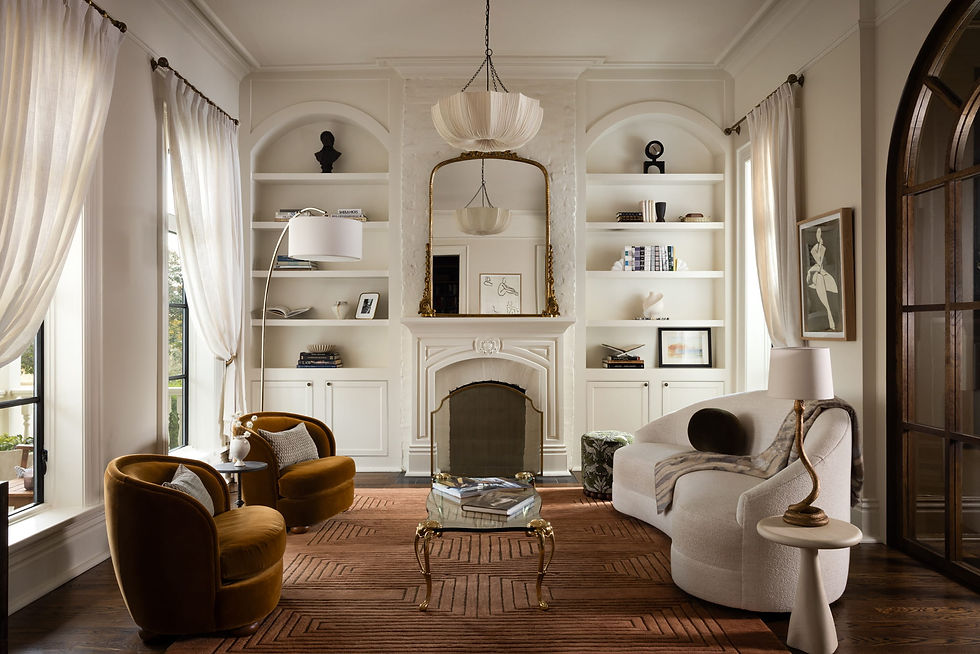
Your home isn't a showroom. It shouldn't look like one. And if you're a recovering symmetry lover like me, this is your permission slip to break the mirror.



Comments