


The Art of Styling Shelves (Without Making Them Look Like a Store Display)
There is a moment in every project where the construction is done, the furniture is placed, the lighting is set, and then someone turns to the shelves and says, "So what do we put on these?"
It's a fair question. And it's one that trips people up more than almost anything else in a room. Because a shelf is deceptively simple. It's just a flat surface. But fill it wrong and the whole room feels cluttered. Leave it too empty and it feels unfinished. Style it too carefully and it looks like a catalog shoot that nobody is allowed to touch.
The shelves are usually the last thing we do in a project, and honestly, they're one of my favorite parts.

Start With What You Actually Own
Before you buy a single thing, pull out what you already have. Books you love. Objects from trips. A piece of pottery your grandmother gave you. A framed photo that's been sitting in a drawer. Candles you forgot about. That weird little sculpture you picked up at a market somewhere and never knew where to put.
Lay it all out on the floor or a table and look at what you've got. You almost always have more than you think. And the things that mean something to you will always look better on a shelf than something you grabbed because you needed to fill a spot.
The Anatomy of a Well-Styled Shelf
Here's what I look for when we're styling shelves for clients. Every good shelf has a few things working together.
Height variation. You need tall things and short things on the same shelf. A stack of books next to a tall vase. A small object in front of a larger one. If everything is the same height, your eye has nowhere to travel and the shelf reads as flat.
A mix of materials. Wood, ceramic, metal, glass, linen, stone. When everything on a shelf is the same material or finish, it blends together and nothing stands out. Contrast is what makes individual pieces feel intentional.
Breathing room. This is the one people struggle with most. Not every inch needs to be filled. Space between objects is just as important as the objects themselves. If your shelf feels crowded, the answer is almost always to remove something, not to rearrange what's already there.
Something organic. A small plant, a branch, dried flowers, a piece of driftwood. Even one natural element breaks up the rigidity and adds life. Shelves without anything organic tend to feel like displays. Shelves with something living in them feel like part of a home.

The Mistakes I See Most Often
The biggest one is treating shelves like a library. Books lined up spine-out, packed tight, nothing else. Books are wonderful on shelves, but they need company. Stack some horizontally. Lean a piece of art against the back wall in front of a row of books. Set a small object on top of a horizontal stack. Let the books be part of the composition, not the whole thing.
The second most common mistake is buying a matching set of decorative objects and spreading them across every shelf. You know the look. A set of three ceramic spheres on one shelf, a matching tray on another, coordinating bookends on a third. It reads as purchased, not collected. The best shelves look like they were built over time by someone with a life and a point of view.
And the third is forgetting about color. You don't need a strict palette, but you do need some thread of connection. If your room is warm and neutral and your shelves are full of bright primary colors, they're going to fight each other. Pull a couple of tones from the room and let those guide your choices.
A Simple Formula That Works
If you want a starting point, try this for each shelf or section of shelves:
One stack of books (horizontal, two to four books)
One tall object (vase, candlestick, sculpture)
One small object (a box, a bowl, a stone, a small framed photo)
One organic element (plant, branch, dried stem)
And then step back and look at the negative space around them. If it feels tight, pull one thing off. If it feels sparse, add one thing back. That's it.
You can repeat this formula across multiple shelves and vary the objects each time. The consistency of the structure keeps things cohesive while the variety of the objects keeps things interesting.
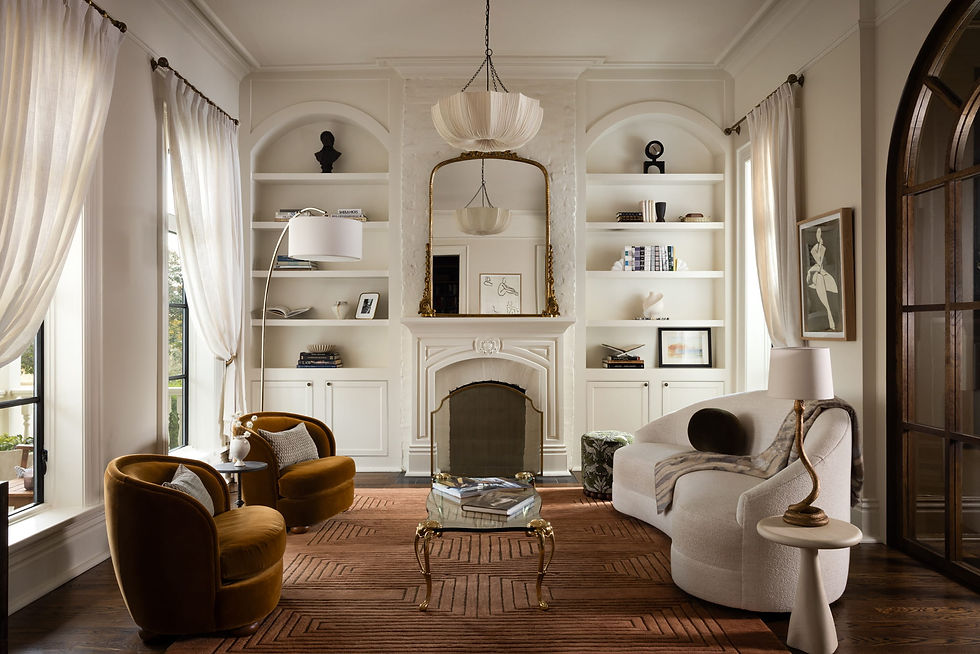
The Real Secret
The shelves that look the best in the homes we design are never the ones we styled in one pass. We place things, step back, swap something out, live with it for a day, and adjust. The willingness to edit is what separates shelves that feel right from shelves that feel forced.
So if you style yours this weekend and it doesn't feel perfect, that's fine. Move things around on Tuesday. Swap in a new object you find next month. Take something off that you've stopped noticing. The best shelves evolve. They're not a finished product. They're a living part of your home.
And if you get three shelves in and want to throw everything on the floor and call someone, well, that's what we're here for.



Comments